Space Policy · National Security
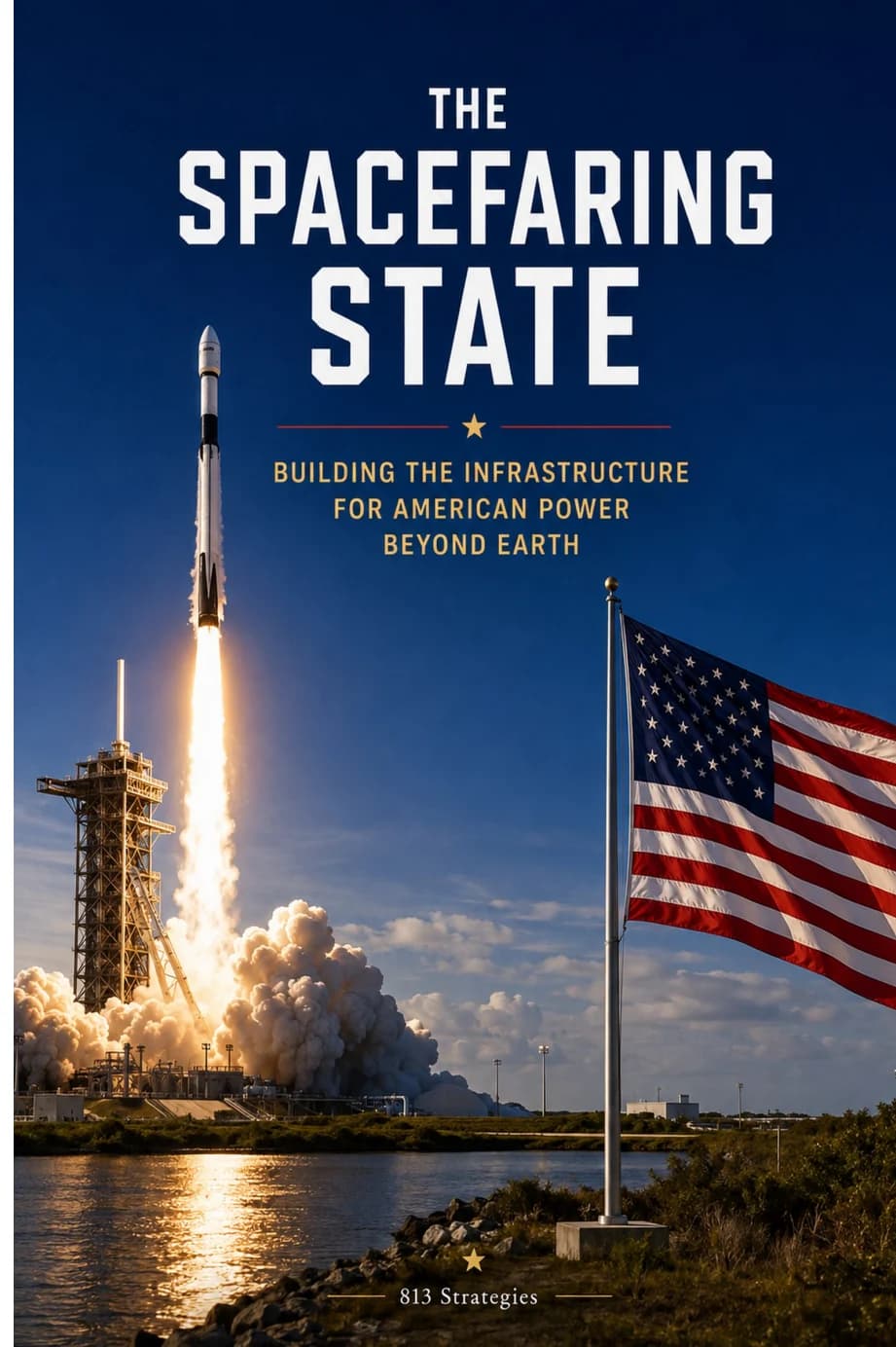
The Spacefaring State
Building the infrastructure for American power beyond Earth: how manufacturing, spaceports, orbital logistics, and military institutions must scale together to turn launch leadership into durable national capacity.
Building the Infrastructure for American Power Beyond Earth
For most of the space age, the rocket was the problem. This report argues that American success in reusable launch is moving the constraint into the systems around it: manufacturing, secure payload processing, roads and ranges, communications, spectrum, skilled workers, and the logistics required to sustain activity in orbit.
Launch counts alone cannot describe usable national capacity. A faster range can expose a processing shortage; new processing bays can shift pressure toward factories, integration teams, or spacecraft commissioning. The national task is to keep removing those constraints as demand grows, while reducing dependence on shared infrastructure whose failure could affect several providers at once.
Resilience Requires Reconstitution
Proliferated military satellite networks can withstand the loss of individual spacecraft, but sustained attrition creates a different test. The report proposes measuring how many militarily useful spacecraft the United States can manufacture, integrate, process, launch, commission, and connect to operational networks within 30, 90, and 180 days. Prepared spares and new production should be measured separately, with the limiting constraint identified at each interval.
Cape Canaveral and Vandenberg should be treated as strategic ports, with secure processing, utilities, transportation, communications, range systems, and specialized workers planned as an interconnected system. Distributed launch options and practical common interfaces can preserve usable pathways when a provider or location becomes unavailable.
A National Space Infrastructure Strategy
The report calls for an interagency space-infrastructure scorecard, investment in common-user assets and secure payload processing, and competitive government demand for orbital transfer, servicing, and refueling. It distinguishes shared public and strategic infrastructure from speculative commercial ventures that must prove their own economics.
Space Force should develop the mobility, logistics, commercial integration, and infrastructure resilience needed to preserve military freedom of action under disruption, while civilian agencies retain their safety, spectrum, science, and exploration responsibilities. The analysis extends this infrastructure approach to sustained lunar activity and argues that the United States should use its current lead to build durable capacity as China works to expand its own reusable-launch and satellite-production systems.