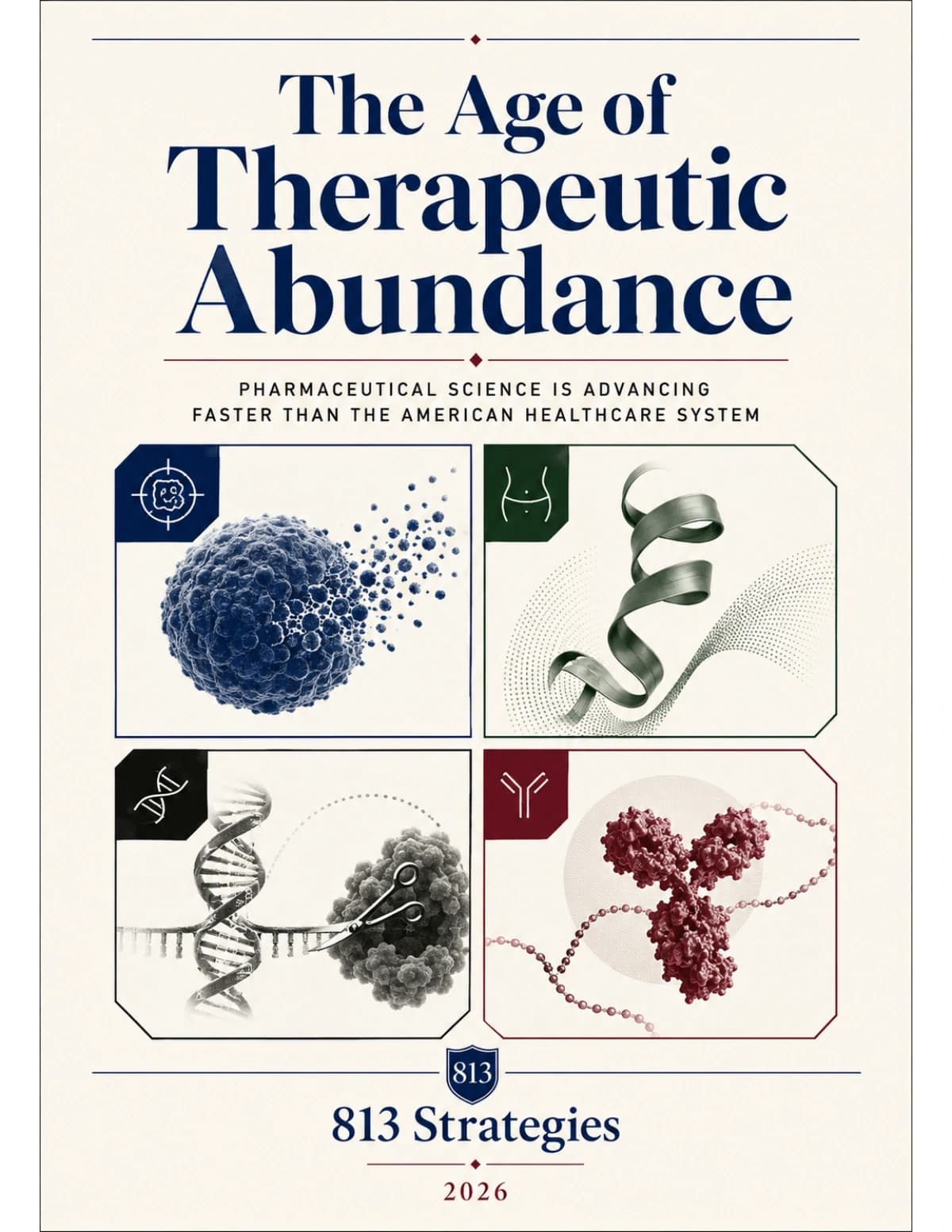
The Age of Therapeutic Abundance
GLP-1 drugs are pushing weight loss toward 30%. CRISPR gene therapy is already approved medicine. Personalized mRNA cancer treatment has reached Phase III, CAR-T is being tested in autoimmune disease, and an AI-directed drug has entered Phase III. The question now is whether the healthcare system can keep up.
Key findings
GLP-1 drugs are changing metabolic medicine.
Semaglutide has reduced major cardiovascular events, while investigational retatrutide has produced Phase III weight loss approaching 30%. Researchers are already testing whether muscle can be preserved as weight falls.
CRISPR gene therapy is already medicine.
Gene-edited stem cells are approved for sickle cell disease, shifting the challenge toward manufacturing, financing and delivery.
Cancer treatment is becoming individualized.
Personalized mRNA cancer treatment, genomics and biomarkers are increasingly linking diagnosis, patient selection and therapy.
CAR-T is moving beyond cancer.
Early human research is testing whether severe autoimmune diseases can sometimes be pushed into durable remission rather than managed indefinitely with immunosuppressive drugs.
Healthcare access is becoming the bottleneck.
Prior authorization, insurance design, drug pricing, manufacturing capacity and specialist treatment infrastructure increasingly determine whether effective medicine actually reaches an eligible patient.
An investigational obesity drug has now produced average weight loss approaching 30% in Phase III. CRISPR-edited stem cells are approved medicine. A cancer treatment manufactured around the mutational fingerprint of an individual patient has produced a positive Phase III result. Researchers are testing whether autoimmune diseases can be pushed into durable drug-free remission, whether muscle can be preserved while fat disappears, and whether artificial intelligence can find useful drug targets and molecules faster than conventional discovery.
These advances come from different technologies and operate against different diseases, but they are arriving at roughly the same time. Medicine is gaining more ways to intervene upstream in disease, target the biology of an individual patient, or alter the biological process itself.
GLP-1 Drugs and the New Metabolic Medicine
Obesity medicine makes the scale easiest to see. Semaglutide produced 14.9% mean weight loss after 68 weeks in the 1,961-patient STEP 1 trial. Tirzepatide moved mean reductions beyond 20% in SURMOUNT-1. Lilly reported in May 2026 that participants receiving 12 milligrams of the investigational drug retatrutide in Phase III lost an average of 70.3 pounds, or 28.3% of body weight, over 80 weeks; 45.3% lost at least 30% of their starting weight. Among participants with baseline BMI of at least 35 who continued into a 104-week extension, average loss reached 30.3%.
Obesity sits upstream from an enormous amount of chronic disease. Measured national data show obesity in 40.3% of American adults and overweight in another 32.1%. CDC estimates that 40.1 million Americans had diabetes in 2023 and 115.2 million adults had prediabetes. SELECT has already shown that semaglutide can reduce the combined risk of cardiovascular death, nonfatal myocardial infarction or nonfatal stroke by 20% in adults with overweight or obesity and established cardiovascular disease but without diabetes.
Researchers are now trying to manipulate what kind of tissue disappears during aggressive weight loss. In a randomized Phase II trial published in Nature Medicine in June 2026, the anti-myostatin antibody apitegromab preserved 54.9% of the lean mass that otherwise would have been lost during tirzepatide treatment. Regeneron is pursuing a similar strategy with semaglutide and its own muscle-preservation combinations. Weight loss is beginning to become a problem of body composition rather than a single number on a scale.
Scale is developing alongside efficacy. FDA approved orforglipron, marketed as Foundayo, in April 2026 as a once-daily oral small-molecule GLP-1 receptor agonist for chronic weight management. Its pivotal Phase III trial produced 11.1% mean weight reduction at 72 weeks at the highest studied dose. That is less than the best injectable therapies, but a pill that is easier to manufacture, distribute and take can serve a very different market. Tens of millions of patients are unlikely to be treated with one drug at one dose through one delivery system.
Personalized mRNA Cancer Treatment and Precision Medicine
Cancer medicine is moving in the opposite direction, toward increasingly individualized treatment. On August 19, 2026, Merck and Moderna announced that intismeran autogene, an mRNA therapy manufactured around the mutational fingerprint of each patient's tumor, met both its recurrence-free-survival and distant-metastasis-free-survival endpoints in a randomized Phase III melanoma trial involving 1,137 patients. Each product can encode as many as 34 neoantigens selected from that patient's cancer.
Nine days later, BioNTech terminated a Phase II trial of another individualized mRNA treatment in resected colorectal cancer after an independent monitoring board concluded that continued treatment was unlikely to change the efficacy outcome and identified a numerical imbalance in overall survival.
Those two results belong together. Personalized cancer medicine has advanced far enough that different products, combinations and tumor types are succeeding and failing in meaningful human trials. Patient-specific pharmaceutical manufacturing has moved beyond a laboratory demonstration.
CRISPR Gene Therapy Is Already Medicine
Cell and gene therapy have crossed an even more basic threshold. Casgevy became the first FDA-approved CRISPR-based treatment in 2023, and in July 2026 its indication was expanded to patients age two and older with sickle cell disease with recurrent vaso-occlusive crises or transfusion-dependent beta thalassemia. The treatment edits a patient's own blood-forming stem cells to increase fetal hemoglobin production.
The science is extraordinary. The delivery is difficult. Patients require cell collection, specialized manufacturing, myeloablative conditioning, hospitalization and long-term follow-up. Casgevy entered the market at roughly $2.2 million per patient, while Lyfgenia, a different gene therapy for sickle cell disease, was listed at roughly $3.1 million.
The financing problem was foreseeable enough that CMS had already selected a Medicaid-focused Cell and Gene Therapy Access Model for testing in February 2023, before either therapy reached the U.S. market. The model now negotiates outcomes-based arrangements on behalf of participating Medicaid programs. Thirty-two states, the District of Columbia and Puerto Rico are participating, representing approximately 84% of Medicaid beneficiaries with sickle cell disease. The medicine is forcing insurance accounting to operate on a different clock.
CAR-T and Autoimmune Disease
The same pressure is beginning to appear elsewhere. A 2024 New England Journal of Medicine case series followed 15 patients with severe refractory autoimmune disease after CD19 CAR-T treatment. All eight patients with lupus met the study's remission criterion, while patients with inflammatory myositis and systemic sclerosis achieved major clinical improvements; immunosuppressive therapy was discontinued. Fifteen highly selected patients cannot establish a standard of care, but they are enough to ask a different question: whether selected immune diseases can sometimes be reset deeply enough to produce durable remission rather than managed indefinitely with recurring immunosuppression.
AI Drug Discovery Reaches Phase III
Artificial intelligence belongs in this story more narrowly than the hype sometimes suggests. FDA's Center for Drug Evaluation and Research had experience with more than 500 submissions containing AI components from 2016 through 2023. Rentosertib, whose TNIK target and small-molecule design were developed through an AI-directed platform, produced a preliminary signal in a 71-patient randomized Phase IIa study in idiopathic pulmonary fibrosis and has since advanced into Phase III; the first patient in the GENESIS-IPF-3 trial was dosed on September 10, 2026. Computational target discovery and molecule design have moved from software demonstrations into late-stage human drug development while remaining subject to ordinary pharmaceutical uncertainty.
Peptides, BPC-157 and the Gray Market
The peptide gray market shows another side of therapeutic abundance: people are already experimenting before formal medicine has settled the evidence. BPC-157, TB-500, MOTS-C and other compounds are being marketed for recovery, metabolism, body composition and longevity despite limited human data and uneven quality control.
Demand is not evidence that these compounds work. It is evidence that people are willing to seek pharmacological tools outside the conventional system, creating both a safety problem and a research signal.
Prior Authorization and Healthcare Access
The scientific advance is arriving inside an access system already struggling with ordinary medicine. A KFF analysis of CMS reporting data found that Medicare Advantage insurers made approximately 52.8 million prior-authorization determinations in 2024 and denied roughly 4.1 million requests in whole or in part. Only 11.5% of denials were appealed, but 80.7% of appealed denials were overturned. The 2025 AMA Prior Authorization Physician Survey found an average of 40 prior authorizations per physician each week, consuming roughly 13 hours of physician and staff time.
CMS is trying to modernize that process. Its 2024 rule imposed new electronic and timing standards for many medical services; in April 2026, the agency proposed separate pharmaceutical requirements that would impose electronic standards and, in several federal programs, maximum decision periods of 24 hours for urgent requests and 72 hours for standard requests beginning in 2027.
American laboratories can sequence a tumor and manufacture an individualized therapy around its mutations while the country is still building uniform electronic rules for how an insurer approves the prescription.
The financing problem runs deeper. Beginning July 1, 2026, Medicare's GLP-1 Bridge began providing qualifying Part D beneficiaries certain obesity medicines for a $50 monthly copayment through a national demonstration operating outside ordinary Part D payment. Private employers are moving in the other direction in some cases. Forty-nine percent of large employers covered GLP-1 drugs for weight loss in 2025, but 6% dropped coverage in 2026, another 5% planned or were considering doing so for 2027, and 27% tightened or planned to tighten utilization controls.
A therapy can work and still be difficult to finance. The payer buys the drug today; the avoided heart attack, dialysis episode, disability claim or cancer recurrence may come years later, perhaps after the patient has moved to another insurer.
For much of modern medicine, finding something that worked was the dominant constraint. That constraint is beginning to loosen in several important fields. The pressure is moving downstream into manufacturing, diagnostics, financing, insurance rules, treatment capacity and the time required to get an eligible patient through all of them.
The United States does not need to approve every drug, pay every price or eliminate scrutiny. Failed drugs should fail. Weak evidence should remain weak evidence. Clinically interchangeable products should compete aggressively on price.
Once strong evidence exists and a patient clearly qualifies, however, the system has to be capable of acting on that information.
Therapeutic abundance will matter only if medicine can actually reach the people it was invented for.